
How Humble's Climate Affects Concrete Curing
Average summer highs of 93°F and year-round humidity that rarely lets up — that’s the climate reality every concrete pour in Humble has to work with. Curing is the process by which concrete gains its strength over time, and it’s far more sensitive to weather than most homeowners assume. A pour that looks perfectly fine on day one can develop surface cracking or reduced durability if curing wasn’t managed properly for the conditions. This guide explains what curing actually involves, how Humble’s climate affects it, and what homeowners should expect and ask about during a project.
Have Questions About Curing for Your Project?
We manage curing carefully for Humble's climate on every job.
Why Curing Matters for Humble Homeowners
Curing isn’t just “letting concrete dry” — it’s a chemical reaction (hydration) between cement and water that continues for weeks after the pour, gradually increasing the concrete’s strength. If the surface dries out too quickly — which happens easily in Humble’s heat — the hydration reaction can stop near the surface before it’s complete, leading to a weaker, more crack-prone top layer even if the concrete underneath is fine.
This matters because surface-level problems — dusting, scaling, hairline cracking — are often curing-related issues that show up months or years after installation, not immediately. For homeowners near the Humble Museum or anywhere across the city, understanding that proper curing is an active process (not something that just happens automatically) helps explain why the days immediately after a pour matter just as much as the pour itself.
Curing Methods Used in Humble’s Climate
Wet curing involves keeping the concrete surface continuously moist — through misting, soaker hoses, or wet burlap — for several days after the pour. This is one of the most effective methods for combating Humble’s rapid surface drying in hot weather.
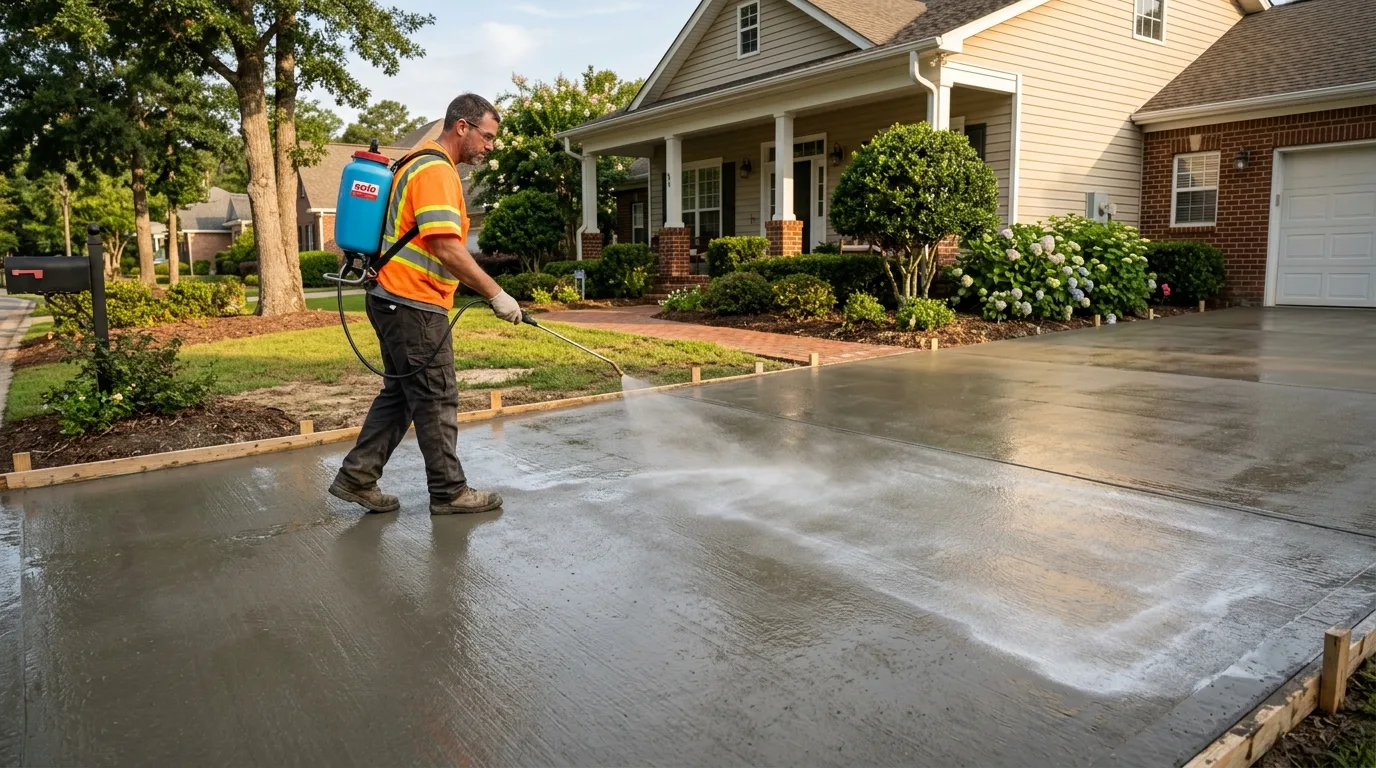
Curing compounds are sprayed onto the surface to form a film that traps moisture in the concrete, reducing the need for manual watering. These are commonly used for larger areas like driveways and commercial slabs.
Evaporation retarders are applied during the finishing process (not after) to slow surface moisture loss while the concrete is still being worked — particularly important for hot-weather pours where the surface can dry before finishing is even complete.
Insulating blankets are used less often in Humble than in colder climates, but can be helpful during occasional winter cold snaps to maintain the temperature needed for normal curing.
Practical Things to Know About Curing Timelines
Here’s what homeowners in Humble should generally expect during the curing process:
- The first 24–48 hours are the most critical. This is when the concrete is most vulnerable to rapid moisture loss, which is why curing measures are applied immediately after finishing.
- Foot traffic is usually fine within a couple of days, but walking on fresh concrete too early can leave marks or affect the surface finish.
- Vehicle traffic should wait about a week to allow the concrete to develop enough strength to handle the load without surface damage.
- Full strength takes about 28 days, though the concrete will be functional well before that — this is more relevant for structural applications than typical driveways and patios.
- Hot weather doesn’t mean faster “done” curing — it means faster surface drying, which is actually a risk factor that requires more curing attention, not less.
- Rain shortly after a pour can be a problem if it occurs before the surface has set enough to resist marking — but established curing methods (like curing compounds) can also help protect against this.
How We Manage Curing on Humble Projects
When we pour concrete in Humble, curing planning starts before the pour itself — based on the season, the time of day, and the forecast. For summer pours, we typically schedule for early morning to give the concrete a head start before peak heat, and we apply curing compounds or use wet curing methods to maintain surface moisture during the hottest part of the day.
For larger pours like driveways and commercial slabs, we may use a combination of methods — for example, an evaporation retarder during finishing followed by a curing compound application. The goal is always the same: give the concrete the moisture and temperature conditions it needs to develop full strength, regardless of what the weather is doing outside.
Get a Project Plan That Accounts for Humble's Climate
We build curing plans around the season and weather for every job.
Cost Factors Related to Curing and Climate
Curing methods are generally included as part of a standard concrete installation in the $4–$10 per square foot range typical for Humble projects, rather than priced as a separate add-on for most residential work.
That said, project timing can have a modest effect — summer pours that require more intensive curing measures (wet curing over multiple days, additional site visits to maintain moisture) may involve slightly more labor than a spring or fall pour with standard curing. Project size affects how curing is approached — larger areas like driveways and commercial slabs are more likely to use sprayed curing compounds for efficiency, while smaller areas might use wet curing methods. Weather monitoring and schedule adjustments, while not a direct line-item cost, are part of how we protect your investment — a contractor who’s willing to adjust timing for weather is protecting the long-term durability of your concrete, which has real value even if it’s not a separate charge.
Frequently Asked Questions
How can I tell if my concrete was cured properly?
Properly cured concrete typically has a uniform color and texture without significant dusting, flaking, or fine surface cracking (sometimes called “crazing”) that can appear in the months after installation. If you notice these issues on relatively new concrete, it could indicate the surface dried too quickly during curing — though it’s worth having it evaluated, since some surface variation can also result from other factors like finishing technique or mix design.
Do I need to do anything to help my new concrete cure after the contractor leaves?
In most cases, no — if curing compounds or other methods were applied during installation, the concrete is set up to cure on its own. However, your contractor should give you specific guidance on when it’s safe to walk or drive on the new concrete, and whether you need to avoid activities like power washing or sealing for a certain period while the concrete continues to gain strength.
Does humidity help or hurt concrete curing in Humble?
It’s a bit of both. High humidity can actually slow surface moisture loss compared to dry heat, which in some ways helps curing — but Humble’s combination of high heat AND humidity creates its own challenges, since the concrete surface can still dry faster than the interior, especially in direct sun. This is part of why active curing methods (wet curing, curing compounds) are so commonly used here rather than just “letting it sit.”
How does winter affect curing in Humble compared to summer?
Winter curing challenges in Humble are the opposite of summer’s — instead of managing rapid moisture loss, the concern during occasional cold snaps (below 40°F) is that low temperatures slow the hydration reaction down, which can delay strength gain and create freeze risk for concrete that hasn’t yet hardened enough to resist ice formation. Because Humble’s winters are generally mild, this is less common than summer heat management, but it’s still something we monitor for any project scheduled during a cold snap.
Curious about how we’d manage curing for your specific project? We’re happy to walk through our process.
Talk to Humble Concrete Pros About Your Project
Get a free estimate and curing plan tailored to your timeline.