
Before and After: A Concrete Driveway Transformation in Humble
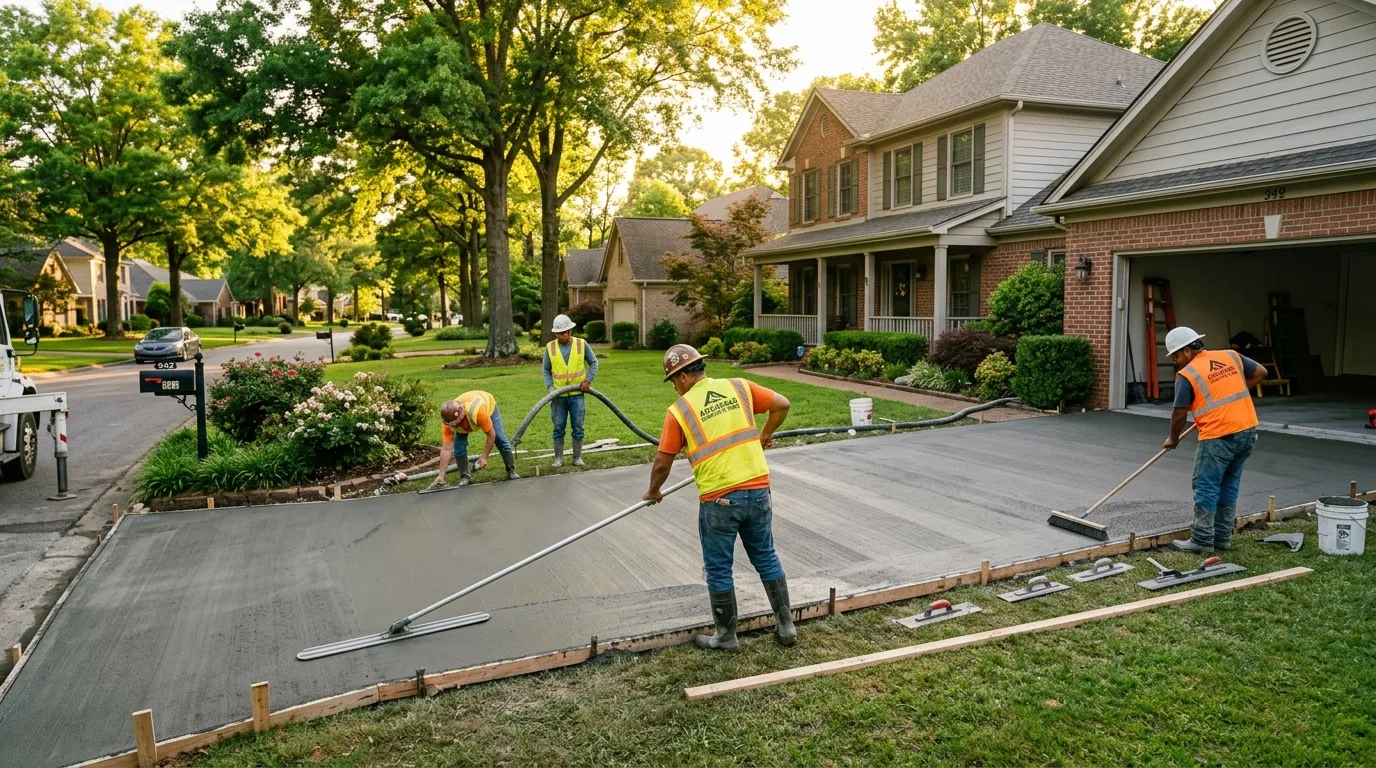
A driveway that’s developed multiple cracks over 1/4 inch wide, with one corner visibly settled lower than the rest — that’s the kind of starting point that often leads homeowners to wonder whether repair or full replacement makes more sense. This post walks through what a typical driveway replacement project looks like in Humble, from initial assessment to finished result, using a composite of common scenarios we see across the area.
Have a Driveway That's Seen Better Days?
We'll assess it and help you decide between repair and replacement.
Why This Kind of Project Is Common in Humble
Driveways that are 15 to 20-plus years old in Humble have typically been through many cycles of Harris County’s expansive Houston Black clay soil expanding and contracting with seasonal moisture changes. Over enough cycles, even a reasonably well-built driveway can develop multiple cracks, and in some cases, sections that have settled unevenly relative to each other.
When a driveway reaches this point, the decision between extensive repair and full replacement often comes down to the number and severity of issues — a driveway with isolated cracks might be a good repair candidate, while one with widespread cracking, multiple settled sections, and significant wear is often a better candidate for replacement, especially if a homeowner is also considering upgrading the finish at the same time.
The Replacement Process, Step by Step
Assessment and planning starts with evaluating the existing driveway’s condition, discussing the homeowner’s goals (replacement in kind, size changes, finish upgrades), and assessing the site’s soil and drainage conditions.
Removal of existing concrete involves breaking up and hauling away the old driveway, which adds time and cost compared to a new installation on bare ground but is a necessary step for replacement projects.
Base preparation is where much of the long-term performance is determined — proper excavation depth, compacted aggregate base, and grading for drainage, all informed by the specific soil conditions on site.
Forming, reinforcement, and pour involves setting forms to the new driveway’s dimensions, placing reinforcement (rebar or wire mesh) appropriate for the application, and pouring and finishing the concrete.
Curing and finishing touches include the curing process appropriate for the season, plus any sealing or finishing work depending on the chosen finish.
Practical Things That Often Change in a Replacement
Beyond simply pouring new concrete in the same footprint, replacement projects often include:
- Improved base preparation compared to what may have been standard practice when the original driveway was installed years or decades ago.
- Updated reinforcement — older driveways sometimes had minimal or no reinforcement, while modern installations typically include rebar or wire mesh appropriate for the application.
- Better drainage grading to direct water away from the driveway and surrounding soil, addressing one of the contributing factors to the original cracking.
- Size adjustments — some homeowners choose to widen a driveway or add a parking pad as part of a replacement project, since the area is already being excavated.
- Finish upgrades — replacement is a natural opportunity to consider stamped or decorative concrete for a different look, since the cost difference is often more manageable when it’s part of a larger project already underway.
- Updated control joint placement to better manage where future cracking (which is normal over a 25-plus year lifespan) will occur.
What the “After” Typically Looks Like
The most immediately visible change is usually a clean, even surface without the cracks, settling, or staining of the original driveway. But the less visible changes — improved base preparation, updated reinforcement, better drainage — are what set the new driveway up to perform differently over its lifespan than the one it replaced.
For homeowners who also chose a finish upgrade (stamped or colored concrete, for example), the visual transformation can be substantial — turning a purely functional driveway into a feature that adds curb appeal. Even without a finish change, a clean, level, properly-prepared driveway is often a noticeable improvement that homeowners describe as making the whole front of the house look different.
Ready to Start Your Own Driveway Transformation?
We'll walk you through the process from assessment to finished project.
What Affects the Cost of a Driveway Replacement
A typical 2-car driveway replacement in Humble runs $4,500 to $9,500, depending on size and finish, with plain concrete at $5–$10 per square foot and stamped or decorative finishes at $9–$16.25 per square foot. You can estimate a range for your specific driveway with our cost calculator.
Removal of existing concrete adds cost compared to new installations on bare ground, since it requires demolition and hauling. Size and shape changes — widening a driveway or changing its footprint — affect both material quantities and labor. Finish choice is a major factor, with the gap between plain and stamped concrete becoming more significant at driveway scale. Timing can play a role too — scheduling a replacement during spring or fall aligns with the most favorable curing conditions, though projects proceed successfully throughout the year with appropriate adjustments.
Frequently Asked Questions
How long does a full driveway replacement take?
Most residential driveway replacements take a few days for the active construction phase — demolition, base preparation, forming, and pouring — followed by a curing period before the driveway can handle vehicle traffic, typically about a week. Weather and project size can affect the exact timeline, and we’ll provide a specific estimate as part of your project plan.
Can I park somewhere else during the project?
Yes, and this is something we’ll discuss as part of planning — most homeowners use street parking or a section of their property not affected by the work during the demolition, pour, and initial curing phases. We’ll let you know when each phase is expected to begin and end so you can plan accordingly.
Is it worth upgrading to stamped concrete during a replacement?
It depends on your budget and goals. Since the area is already being excavated and prepared regardless of finish, the additional cost for stamped concrete during a replacement is sometimes more proportionally manageable than adding a stamped finish as a standalone project later. That said, plain concrete is a perfectly good choice if budget is a priority — there’s no requirement to upgrade just because you’re already replacing the driveway.
Will my new driveway crack eventually too?
Some minor cracking over a 25-plus year lifespan is normal for concrete in Harris County’s clay soil, even with excellent preparation — the goal of proper base preparation, reinforcement, and control joints is to manage where and how minor cracking occurs, not to guarantee zero cracks ever. The difference with a well-prepared replacement is that any future cracking tends to be minor, controlled at joints, and far less likely to involve the kind of settling that often prompts replacement in the first place.
If your driveway is showing its age, we’re happy to take a look and talk through your options — repair, replacement, or somewhere in between.
Get Your Driveway Assessment From Humble Concrete Pros
Free evaluation and a clear recommendation, no pressure.